Local women’s stories inspire cervical screening campaign, Women’s Business, Women’s Way
23 November 2026
A community-led campaign unveiled today has been shaped by local Aboriginal women’s lived experiences to encourage more women to take part in cervical screening.
The Women’s Business, Women’s Way initiative brings together Aboriginal women, health organisations, Aboriginal Health Workers, general practices, Elders and community members to improve access to culturally safe cervical screening across the Illawarra Shoalhaven.
The initiative is led by COORDINARE – South Eastern NSW PHN in partnership with Grand Pacific Health, Illawarra Shoalhaven Local Health District, local general practices and community, with support from a Cancer Institute NSW Cervical Screening Community Engagement Grant.
COORDINARE's CEO Prudence Buist said Women’s Business, Women’s Way recognises that meaningful and lasting change must be shaped by the women it is intended to support.
“Local Aboriginal women have generously shared their stories, experiences and knowledge to help us better understand the barriers they face when accessing cervical screening.
“The beautiful artwork that is the centrepiece of the campaign brings those stories together and will help start important conversations about cervical screening in families and communities across the Illawarra and Shoalhaven,” she said.
“Their voices have guided every stage of this initiative, from the artwork and community resources to the screening days and education being developed for health professionals.
“By listening to community and acting on what women have told us, we can help create health services where Aboriginal women feel safe, respected and empowered to make decisions about their health,” Ms Buist said.
National data shows that 51% of Aboriginal and Torres Strait Islander women participated in cervical screening in the five years to 2025, compared with 78% of the eligible population nationally. Mortality among Aboriginal and Torres Strait Islander women was more than three times the rate for non-Indigenous women between 2019 and 2023.
Yarning circles were facilitated by Aboriginal counsellor and cultural consultant Carlie Schofield with Aboriginal women and Elders from across the Illawarra and Shoalhaven. The conversations explored women’s experiences of cervical screening, including the barriers that can make it difficult to access care and what culturally safe support should look like.
“The yarning circles created space for women to share honestly and safely. What they told us has helped shape resources and activities that reflect their experiences, strengths and cultural knowledge,” Ms Buist said.
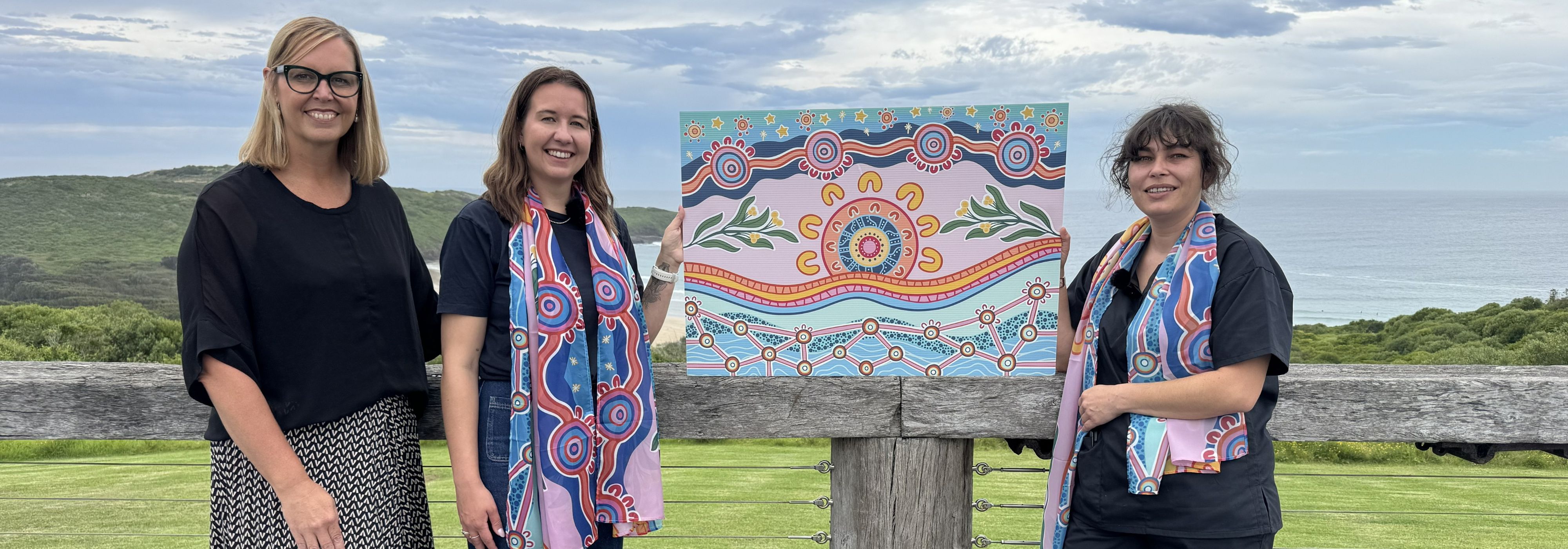
Wodi Wodi, Walbunja artist and Yirra Miya Cultural Creative Lead Lauren Henry, has created an artwork inspired by the stories, strength, experiences and wisdom shared by the women that will feature across community education, awareness and screening resources.
Lauren said the artwork carries the stories of First Nations women across the Illawarra and Shoalhaven, including their strength, vulnerability and courage in sharing experiences that are deeply personal.
“It reflects our connection to Country, culture and community, and our commitment to creating positive change for the women who will journey after us. At its centre is a meeting place symbolising the culturally safe space created for women to yarn about their experiences and the barriers they face. Connected meeting places represent women across the Illawarra and Shoalhaven being supported throughout their cervical screening journey.
“Waterways represent the sharing of knowledge, stories and experiences, while native wattles symbolise Aboriginal women’s resilience, growth and courage. Stars acknowledge women who have experienced cervical cancer and those guiding efforts to create meaningful change.
“I thank every woman who contributed for their courage, trust and knowledge,” said Ms Henry.
Community days were held last week during Cervical Cancer Week in Dapto, Bellambi and Sanctuary Point for local communities. The Women’s Business, Women’s Way initiative is also developing education for general practices and health professionals based on community feedback. This includes addressing barriers such as shame, misinformation, discomfort discussing sexual health and a lack of cultural safety when speaking about private health matters.
Women and people with a cervix aged 25 to 74 are eligible for cervical screening every five years. They can choose to collect their own sample in private at a health service or have a doctor or nurse collect it. Both methods are safe, effective and accurate.
Read more about the Women’s Business, Women’s Way artwork here.
Background notes
*1 Australian Institute of Health and Welfare. (2023). Indigenous primary health care: Results from the OSR and nKPI collections—Cervical screening (PI22). AIHW. https://www.aihw.gov.au/reports/indigenous-australians/indigenous-primary-health-care-results-osr-nkpi/contents/nkpi-preventative-health-indicators/cervical-screening-pi22
*2 Australian Institute of Health and Welfare (AIHW). (2024). Cervical screening in Australia 2024. Cancer series no. 163. Cat. no. CAN 142. AIHW. https://www.aihw.gov.au/reports/cancer/cervical-screening-in-australia-2024
Pictured: Prudence Buist, COORDINARE's CEO, Wodi Wodi, Walbunja artist Lauren Henry and Shayne Mook, practice nurse, King Street Medical unveil the artwork commissioned for the Women's Business, Women's Way initiative.